James Webb Pillars of Creation



Loading options…
- Museum-quality archival, acid-free paper
- Ships rolled in a durable tube
- Usually ready to ship in 5–7 business days
About this image
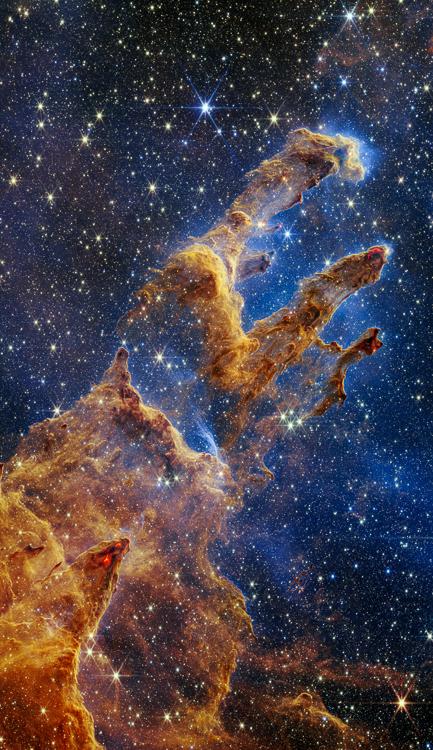
The Pillars of Creation are set off in a kaleidoscope of color in NASA’s James Webb Space Telescope’s near-infrared-light view. The pillars look like arches and spires rising out of a desert landscape, but are filled with semi-transparent gas and dust, and ever changing. This is a region where young stars are forming – or have barely burst from their dusty cocoons as they continue to form.
Newly formed stars are the scene-stealers in this Near-Infrared Camera (NIRCam) image. These are the bright red orbs that sometimes appear with eight diffraction spikes. When knots with sufficient mass form within the pillars, they begin to collapse under their own gravity, slowly heat up, and eventually begin shining brightly.
Along the edges of the pillars are wavy lines that look like lava. These are ejections from stars that are still forming. Young stars periodically shoot out supersonic jets that can interact within clouds of material, like these thick pillars of gas and dust. This sometimes also results in bow shocks, which can form wavy patterns like a boat does as it moves through water. These young stars are estimated to be only a few hundred thousand years old, and will continue to form for millions of years.
Although it may appear that near-infrared light has allowed Webb to “pierce through” the background to reveal great cosmic distances beyond the pillars, the interstellar medium stands in the way, like a drawn curtain.
This is also the reason why there are no distant galaxies in this view. This translucent layer of gas blocks our view of the deeper universe. Plus, dust is lit up by the collective light from the packed “party” of stars that have burst free from the pillars. It’s like standing in a well-lit room looking out a window – the interior light reflects on the pane, obscuring the scene outside and, in turn, illuminating the activity at the party inside.
Webb’s new view of the Pillars of Creation will help researchers revamp models of star formation. By identifying far more precise star populations, along with the quantities of gas and dust in the region, they will begin to build a clearer understanding of how stars form and burst out of these clouds over millions of years.
The Pillars of Creation is a small region within the vast Eagle Nebula, which lies 6,500 light-years away.
Webb’s NIRCam was built by a team at the University of Arizona and Lockheed Martin’s Advanced Technology Center.
Similar images


What my clients say
Beautiful picture!
I saw a beautiful picture of a lotus that would look perfect in our home, however the larger size that I needed wasn't an option for purchase. I reached out to Adam and he was quick to reply and happy to provide me with the 48 x 48 dimensions that I needed. The large canvas was shipped and arrived in perfect condition. I love it and this will bring us a lot of happiness seeing this beautiful picture placed behind our buddha fountain. We are very happy and Adam was very kind and responsive with providing me with delivery dates too.
My wife and I were looking for photos of places we have been to showcase within our home, highlighting some of the adventures that we had been on together. Adam had coincidentally been to a few of the places that we have recently seen. His eye for photography and capturing scenes that we had been to in person are superb! Looking forwards to more adventures with my wife, and seeing Adam's perspective on what those places show.